
Features

What can gold do for you?

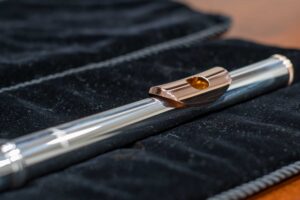
Hey there! I’m back from a wonderful vacation with my family-it’s so good to be able to get out and travel again! We spent a week in beautiful Virginia Beach, where my toddler thoroughly enjoyed her first time in the ocean. Now I’m back in the shop and diving into several exciting projects to bring helpful information to new and experienced players alike! When customers walk into the Indy Flute Shop, many are immediately drawn to a select number of instruments that feature gold on the lip plate. It is certainly a striking visual difference, and it begs the question–is it solid gold? How much does that cost? Does it really make a difference to the sound? Well, it depends, but usually the answer to the last question is yes! Changing the material on any part of the flute will certainly change the sound, whether you’re looking for more projection, greater warmth, or a darker sound. Any player who has compared a silver-plated student flute to an intermediate or advanced one from the shop, for example, will know that sterling silver will add a huge amount of “oomph” to the sound versus a simply plated instrument. Gold can do the
Read More

Open-holed flutes

I’ve been getting a lot of questions lately from parents coming in to upgrade their student’s flute about the purpose of open-holed keys on the flute. Truth be told, there are a lot of differing philosophies about this subject, and the trends are different depending on where you are in the world, believe it or not! Here are some of the most basic reasons for why most flutes you’ll encounter, besides student flutes, will have open holes. As flutes evolved from an instrument with no keys but simply holes which were covered by the fingers, to ring keys (similar to a clarinet), to the traditional keys we see on French-style flutes today, open holes have generally been the standard of how keys were constructed, particularly in the United States. Plateau-style, or closed-hole keys, came a bit later and are almost universally used on student flutes, as the player gets used to the proper hand position. Once a flutist upgrades to an intermediate step-up flute or higher, open holes becomes the new standard. This feature requires more accurate finger placement on the keys, which can improve technique. As a flutist transitions from closed to open holes, plugs made of plastic, silicone,

Read More

Caring for your wood piccolo

As the temperature drops in the Midwest and we settle squarely into the colder months of the year, I wanted to take a few minutes to discuss a very important subject: the care required for wooden instruments, specifically piccolos. Wood is much more susceptible to temperature and humidity changes than metal, and sudden changes or poor maintenance can lead to serious issues like cracking and warping of the instrument. With just a few precautions, you can keep your wood piccolo looking and playing like new for years to come. Most wood piccolos are made of grenadilla wood, which as I mentioned is susceptible to cracking as temperatures rise and fall, especially in the Midwest, where most of us are stationed. Therefore, wood instruments are strongly discouraged for outside playing, especially in a marching band setting. Just as with string instruments and wood clarinets and oboes, the bodies of piccolos can actually crack due to temperature fluctuations, which causes the wood to swell and shrink, compromising the integrity of the body. The simplest way to avoid this is–say it with me–avoiding temperature and humidity extremes. Be sure to always swab out your piccolo after you have played it as well, to

Read More

D# roller

This week, the latest in a series of “Things that Make your Life Easier as a Flute Player:” the D# roller! Traditionally an advanced feature, the D# roller can be found as an option on semi-professional and handmade flutes. If you’ve been playing flute for any length of time and have worked on repertoire in the low range, you know that it gets quite tricky to move around in the D#-D-C#-C area. Especially tricky is the pesky transition from D#-C#, where the pinky finger has to slide between those keys without causing a “blip” between the notes. The D# roller solves that problem by situating–you guessed it–a roller at the edge of the D# key to help the movement around those notes. (photo courtesy Altus) The Indy Flute Shop currently has a great selection of semi-professional and handmade flutes with this feature: a Miyazawa 202, 402, 602, and a handmade Altus 1607. Make an appointment to stop by and check one out today!

Read More

Archive: French key arms

When I wrote a blog post about French pointed key arms back in 2015, most step-up brands that I carried in the shop still came with Y-cup arms, which has been the standard for beginner and intermediate flutes for years. Since then, the intermediate flute world has just exploded with brands, features, and options, and now it is much more common for these level flutes to come with French key arms. In fact, every instrument in the Indy Flute Shop (with the exception of some older closeout models) now has this feature! Read the blog for more information. This week’s burning question: What are French pointed key arms, and how do they differ from “regular” keys?French pointed key arms have traditionally been a feature on semi-professional and professional-grade instruments, due to their handmade features and greater time associated with creating them. Unlike the traditional “Y-cup” arms that are found on student and some step-up instruments, French key arms consist of a pointed tone arm that extends to the center on the pad cup and is soldered to the top of the cup. This type of construction is stronger than the standard “Y” cup mounting where the tonearm is soldered to

Read More
Azumi AZ3BOP
Features

Product Feature: The Azumi AZ3BOP

  Azumi flutes has been making dependable, professional sounding step-up flutes at a great price point for years. Azumi flutes feature professional handmade Altus headjoints. This combination allows you to get the great playing characteristics of the legendary Altus flute brand at price great for middle and high school students. The Indy Flute Shop has a limited number of the new Azumi AZ3BOP flute available. This flute features a beautiful rose gold lip plate and crown on its incredible Altus Professional .925 Sterling Silver Z-Cut™ Headjoint. Not only does it provide a rich tone, it also is incredibly stylish! This instrument is available for outright purchase AND on the Indy Flute Shop rent-to-own program. Stop by today to trial this fantastic instrument! Specs: Open Hole, Offset G, B Foot, Gizmo Key, Altus Professional .925 Sterling Silver Z-Cut™ Headjoint, Rose Gold lip plate and crown, .925 Sterling Silver Body, silver-plated keys and mechanism, Altus-Bennett Scale, wide rib construction, French-style pointed key arms, stainless steel springs, French case and cover

Read More

FAQ: How do I get my instrument repaired?

Have you or your student recently started back to school, only to find that your playing is a bit…rusty? Don’t worry, we won’t judge you. Lots of students take the summers easy when it comes to playing your flute, and you may find that when you pick it back up again, that it is in need of some repair and maintenance. We have you covered! Sending an instrument into Paige’s Music for repair is a very easy process. Here’s what you need to do: How Do I Get My Instrument Repaired? – FAQ | Paige’s Music News about band and orchestra rentals, sales and service in Indiana 1. Call us at 1-800-382-1099 to let us know that your instrument needs service. We’ll arrange for a loaner to be sent to your school so your student isn’t without an instrument for class. TIP: You’ll need to keep your accessories and cleaning items with you so that you’ll have them to use with the loaner until your instrument is returned to you. 2. Our District Manager will bring the loaner with him on his next visit to your school. He will also pick up your instrument and bring it back to the

Read More

Density 21.5

Whether you are a fan of atonal music or prefer to stick with the more melodic side of things (I will unashamedly admit I am of the latter party), you are probably familiar with what has traditionally been known as the most famous atonal work for flute, “Density 21.5” by Edgard Varèse. It was written for solo flute, without piano accompaniment, in 1936 and revised in 1946 and remains for many flute players the introduction into 20th century atonal music. “Density 21.5” was written by Varèse at the request of George Barrere for the commission of his Haynes platinum alloy flute. This alloy consisted of 90% platinum and 10% iridium, which together has a density of almost exactly 21.5 grams per cubic centimeter. The cost of this instrument was about $3,750 in 1935—a little over $69,000 today when adjusted for inflation. The piece’s finish in 1936 was followed by a period during which Varèse produced little music; it was, in fact, the last work of any consequence the composer wrote until after World War II. Without delving too deeply into advanced music theory concepts, “Density 21.5” is based on two melodic ideas, one modal and one atonal. “Modal” refers to

Read More

Sergei Prokofiev’s Sonata in D Major

Sergei Prokoviev was a Russian Soviet composer, pianist and conductor and is regarded as one of the major composers of the 20th century. Although he is probably best known for works such as “Peter and the Wolf” and ballets such as “Romeo and Juliet,” his Sonata in D Major for Flute and Piano remains one of the staples of college flute repertoire. The piece highlights his status as one of the leading Neoclassicists of the time and features a wide array of techniques and colors. The Sonata was composed in the summer of 1943 was first performed in Moscow, Russia on December 7, 1943 by Nicolai Kharkovsky (flute) and Sviatoslav Richter (piano). It was later transcribed for violin in 1944. It consists of four movements: Moderato, Scherzo: Presto, Andante, andAllegro con brio. At the same time, Prokofiev was working on music for the film “Ivan the Terrible.” This time period, of course, was during World War II, and Prokofiev had been permanently settled with his family in Moscow. However, during this time of unrest, he—along with a group of other artists—were temporarily placed in the Caucasus region, where they were thought to be safer. Thankfully, the restrictions that had previously been placed on the composer by the strict Soviet

Read More

Flute scales, part 2

A couple of weeks ago, I attempted to dive into the extensive and complicated history of how flutes are built to be in tune with themselves: their scale. To summarize, the flute scale determines how well the notes play in tune to each other, octave to octave, and also determines the timbral balance of the notes. From a mechanical standpoint the flute scale is a function of the following: the diameter of the flute tube or “bore,” the size of each tone hole, the linear location of each tone hole along the flute tube, and the height of each tone hole. Scale should not be confused with the pitch of an instrument. Pitch relates to which “A” the instrument has been designed to produce (e.g., A-440, A-442, etc.) Most instruments made for the U.S. market are typically pitched at A-442, and play well in tune from A-440 to A-444. As we can see, this is a very complex and exact process, and also one with no clear-cut answer or one size fits all method. For flutes that have been built since the mid 1900s, most of them have been constructed using either the Cooper scale or, later, the Bennett scale,

Read More

A quick history of flute scales, Part 1

Okay, the title of this post sounds kind of boring, right? Stay with me–I’m not talking about scales in the etude/exercise sense! This week I’m delving into a history of how flutes are built to be in tune with themselves, or its scale. With the help of the justflutes.com blog, I’m going to attempt to break down the different methods and theories of how flutes have evolved in the quest for better intonation throughout history. Let’s first define what exactly we mean by the “scale” of a flute. In its simplest terms, a scale is a set of proportions which, in the instrument world, can be seen in the different placement of frets on a guitar fingerboard and the curve of a rank of organ pipes or piano strings. In equal temperament, these follow a simple mathematical formula. Multiplying by 1.06 (or 1.0594630948 or 12,-2.) increases the overall length proportionately to eventually reach the octave — exactly. Stringed instruments are well behaved and follow this rule closely. Sadly, flutes are not well behaved. Because we move our lips, intonation is a moving target. Before Theobald Böehm, who is largely responsible for our modern flute construction, the concept of “scale” was

Read More

Stretches for flutists

This week’s blog is one from the archives, but it has been one of my favorite projects that I have done so far, so I wanted to share it with everyone again! I have been super sore the past few days: interval workouts, pulling weeds in the backyard, and standing at an exhibit booth all weekend have left me super tight in my back and shoulders. Please enjoy these easy and relaxing exercises, and remember, if you are in pain, seek professional help! I always tell people that flute is not a very ergonomically-friendly instrument–but it IS the most beautiful and the closest to the human voice, so what do we do? We adapt, and we take care of our bodies. Shown below are some easy stretches to lengthen and soothe the neck, shoulders, arms, and hands. PLEASE NOTE: These pictures and the content therein are not a substitute for medical advice. If you are having ongoing pain, I highly recommend that you see a physical therapist or a sports medicine doctor. 1. Gentle neck and shoulder stretch. Slowly drop your head to one side and gently pull your shoulder away from the neck. You can place your hand on

Read More

The Great E Dilemma

Many potential customers find themselves with a dizzying bevy of information when it comes to picking features for their next flute. The possibilities are darn near endless–how can one possibly know which options are best for them? In the blog this week, I break down two common but sometimes hard to decipher features: the split E mechanism versus the high E facilitator. It seems a bit redundant, right? Two different features that purport to do the same thing: ease high note playing and response, particularly the high E natural. Here is some information from Miyazawa’s website to help untangle the differences between the two: The split E mechanism can dramatically improve the response of high E. This mechanism divides the action of the upper and lower G keys, permitting the lower G key to close when high E is played. Closing the lower G key and fingering high E decreases venting and brings more stability to the note with a faster response. This mechanism employs a separate rod, adding a slight bit of weight to the flute. The split E mechanism must be made on the flute during manufacture. The high E facilitator is a donut-shaped ring that is inserted

Read More

C# trill key

Happy September! This week’s blog is one from the archives, but I thought it would be appropriate to post it again since I have so many more followers now than when this video was posted back in 2013–which is awesome! The C# trill key is also fresh in my mind because I just helped a family purchase a wonderful step-up instrument with this feature this past week. Enjoy! C-Sharp Trill Key

Read More

Staff spotlight with yours truly

Hi there! Every month, we at Paige’s Music “spotlight” a member of our team, and this month I was honored to be featured! To learn a little bit more about my background and what I do, please watch the video below. I hope you enjoy it!

Read More

Flute stands

How many of you have been sitting in a rehearsal or practice session, especially those of you who double on piccolo or another instrument, and feel like you’re performing a balancing act with your flute on your lap? Or you’ve found yourself setting your instrument on your chair, or–heaven forbid–the floor? There is a better solution! Flute stands are an inexpensive and easy way to keep your flute safe and secure during a rehearsal or practice. The IFS carries two styles of flute stands: a 3-leg model with a larger base, and a 4-leg model with a smaller, more compact base. They are similar in price and provide the same functionality. We also carry a piccolo stand that is helpful for people who double on both flute and piccolo. These stands are made by Konig and Meyer and are durable and inexpensive. For those of you who double on other woodwind instruments or auxiliary instruments such as alto flute, there are other options available; these usually include a larger base with interchangeable pegs to fit different woodwind instruments. These are not normally stocked in the shop, but can always be special ordered.

Read More

Microphones

I have gotten several questions recently from amateur performers about using a microphone when performing, and that’s a tricky question to answer! Often, a microphone is definitely needed to help amplify an instrument that can be very easily drowned out when playing as an accompaniment to an ensemble–for example, a church choir or a worship team–but how do you amplify the sound without distorting it? Read on! Dynamic mics are the types of microphones you see on a live stage. Singers use them on stage, as do instruments that need to be mic’d. They are, for the most part, inexpensive, can take a beating, and don’t feedback as easily as Condenser mics. A decent, all purpose, dynamic mic can be purchased for $100 – $150. When playing a flute into a dynamic mic it is important to place the lip opening right up to the microphone. This is due to the fact that these mics don’t pick up sounds that are not right next to them (This is why they are harder to feed back). One of the reasons why these mics will not pick up sounds that are not close to them is because they are not as sensitive

Read More

Shokunin

Earlier this year, the Indy Flute Shop and Paige’s Music became a Shokunin Select Dealer. What does Shokunin mean? Yamaha phrases it as: Shokunin (sho-ku-neen) Japanese (n) craftsman, artisan. “The Japanese word shokunin is defined by both Japanese and Japanese-English dictionaries as ‘craftsman’ or ‘artisan,’ but such a literal description does not fully express the deeper meaning. The Japanese apprentice is taught that shokunin means not only having technical skills, but also implies an attitude and social consciousness. The shokunin has a social obligation to work his/her best for the general welfare of the people.”- Toshio Odate At Paige’s Music and the Indy Flute Shop, we feature Yamaha’s highest quality instruments elegantly crafted by Yamaha’s finest luthiers. In the process of designing each Shokunin instrument, each instrument serves as a laboratory for new designs, new features, and a new approach the instrument itself. These instruments are the most innovative and are often the birthplace for features that you will see across the Yamaha range in the future. So what does that mean for flute players? Well, the Indy Flute Shop has been carrying several flute members of the Shokunin line for several years now with the 577 and 677 flute

Read More

Straubinger Phoenix Pads

Many of you know that the Straubinger family is responsible for making some of the very best flutes on the planet. David and Joel Straubinger’s flutes represent the very highest in handcrafted quality, attention to detail, and top-of-the-line materials. Many professional flutes, including several brands carried at the Indy Flute Shop, feature Straubinger pads. These pads, rather than the traditional felt pad, are made of many fine layers of material that make for the utmost in quality, tone control, and precision sealing. And they are made right here in Indianapolis! What many of you may not know, however, is that David and Joel Straubinger’s shop burnt nearly to the ground in November 2008. At the time, they had been working on a prototype pad for an intermediate student flute. Among the ashes, this prototype was found, and the Straubinger Phoenix pad was born, rising from the ashes of the devastating fire. Ideal for use on production step-up flutes, the outer felt covering wraps around the outer rim of the pad instead of stopping at the pad’s edge. The traditional Straubinger design is flipped in a way, making for greater durability in the area where the pad touches the tone hole.

Read More

Brand spotlight: Pearl flutes

This week, I wanted to highlight a brand that many people have heard of, but not necessarily in the context of flutes: Pearl! “But wait, doesn’t Pearl make drums?” is a question that I hear so often when people come into the shop–and the answer is yes! Pearl is very well-known for their fantastic percussion sets and drum kits, but they also make a wide range of wonderful flutes as well! Pearl Musical Instrument Company was founded in 1946, and the company began making flutes in Chiba, Japan in 1968. Their instruments range from high-quality student flutes, which feature a solid silver lip plate riser. This feature differentiates them from most student flutes which are fully plated, to handmade professional instruments in a range of high level materials such as 18k gold and platinum. Pearl flutes are also set apart from many other manufacturers in that their mechanisms are pinless. This setup is unique because instead of the tiny pins that hold together the crucial pieces of many flutes–which can snag and catch–the rods and tenons are instead held together by a series of small screws. This both affects the durability of the instrument and creates a smooth, highly effective

Read More
Categories